
That sharp sting right below the kneecap is a familiar foe for many athletes. Whether you call it patellar tendinopathy, jumper’s knee, or just a massive frustration, it’s a condition that demands more than just pushing through.
At City Osteopathy & Physiotherapy, we combine clinical expertise with advanced technology to help you reclaim your mobility.

What is Patellar Tendinopathy?
Patellar Tendinopathy involves the breakdown of collagen in the tendon rather than simple inflammation. The patellar tendon acts as a vital bridge between your kneecap (patella) and your shinbone (tibia). It is a tough, fibrous band of tissue that allows your quadriceps muscles to straighten your leg. Every time you kick a ball, climb stairs, or sprint for a bus in the CBD, this tendon transmits the force necessary for movement.
Jumper’s Knee vs. Tendonitis
Many people mistakenly use the term tendonitis. However, modern research shows that chronic knee pain is rarely caused by active inflammation. Most cases are actually tendinopathy, a degenerative process where the tendon fails to heal properly under stress. Unlike simple inflammation, this structural weakness requires more than just ice and rest; it requires progressive loading.
Common Symptoms of Patellar Tendinopathy

You may be suffering from Jumper’s Knee if you experience:
- Point-specific pain directly on the patellar tendon (just below the kneecap).
- Morning stiffness or discomfort after sitting for long periods.
- Pain that scales with activity, worsening during jumping, running, or heavy squatting.
- Localised tenderness to the touch.
Why Does Patellar Tendinopathy Happen?
The condition is primarily a volume issue where the load placed on the tendon exceeds its ability to recover. While jumper’s knee implies it only affects basketball or pickleball players, anyone can develop it. Common risk factors include:
- Sudden Load Increase: Ramping up your running mileage or gym intensity too quickly.
- Poor Biomechanics: Issues with foot arch support, hip strength, or ankle mobility that force the knee to overcompensate.
- Hard Training Surfaces: Running on concrete or playing on hard courts.
The 4 Stages of Patellar Tendinopathy Severity
To determine the best recovery timeline, our specialists categorise the injury into four stages:
- Stage 1: Pain only occurs after activity; there is no functional impairment.
- Stage 2: Pain appears at the start of activity, disappears after warming up, but recurs with fatigue.
- Stage 3: Persistent pain during and after activity that limits your ability to perform or play sports.
- Stage 4: A complete tendon rupture is rare but severe, which is a surgical emergency.
The Best Patellar Tendinopathy Exercises for Recovery
Modern rehabilitation focuses on progressive loading to rebuild the tendon’s resilience.
Isometric Holds for Pain Relief
Isometric exercises involve tensing the muscle without moving the joint. Common examples include the Spanish Squat or a seated leg extension hold. These exercises reduce pain levels immediately and often anchor the early phases of treatment.
Heavy Slow Resistance (HSR)
This is the recommended protocol for long-term health. By performing squats or leg presses very slowly with heavy weights, you encourage the tendon to lay down new, healthy collagen fibres. This process takes time but provides the most robust results.
Eccentric Training
Using a slant board for single-leg decline squats focuses on the lowering phase of the movement. This specifically targets the patellar tendon and has been a staple in sports physiotherapy for decades.
How City Osteopathy & Physiotherapy Can Help
Treating patellar tendinopathy requires more than just rest and ice. Because tendons have a poor blood supply, they require a specific, “active” recovery approach to heal. Here is how our team at City Osteopathy & Physiotherapy facilitates your recovery:
1. Expert Diagnosis and Biomechanical Assessment
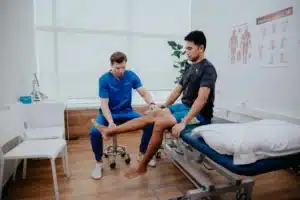
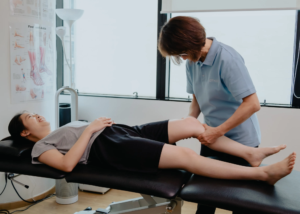
Our first step is to understand why your tendon is overloaded. We perform a comprehensive assessment of your movement patterns. Are your glutes under-firing? Is your ankle mobility restricted? By identifying these “weak links,” we treat the cause, not just the symptom.
2. Tailored Physiotherapy and Load Management
The gold standard for treating patellar tendinopathy is progressive loading. Our physiotherapists design custom exercise programs to gradually strengthen the tendon without overstressing it. These programs often involve specific isometric and eccentric loading.
3. Osteopathic Manual Therapy
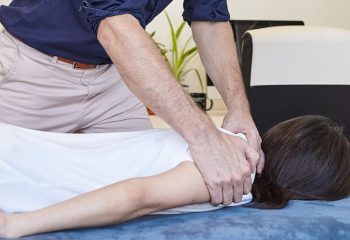
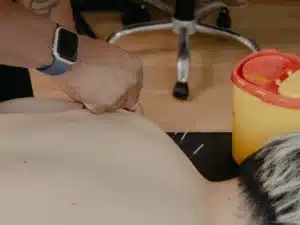
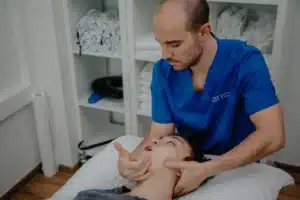
Our osteopaths look at the body as a whole. They may use manual therapy to improve the alignment of your pelvis, hips, and ankles. By ensuring the entire “kinetic chain” is moving correctly, we reduce the disproportionate stress placed on your patellar tendon.
4. Shockwave Therapy (ESWT)
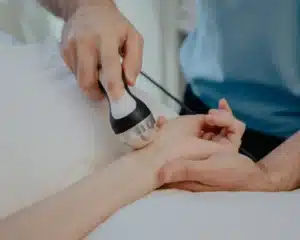
For chronic cases that aren’t responding to traditional exercise alone, City Osteopathy & Physiotherapy offers Shockwave Therapy. This non-invasive treatment sends acoustic waves into the tendon tissue, stimulating blood flow and triggering the body’s natural healing response.
Frequently Asked Questions About Patellar Tendinopathy
How long does it take for Patellar Tendinopathy to heal?
Recovery timelines vary depending on the severity (Stage 1 vs. Stage 3). Mild cases may resolve in 4 to 6 weeks with proper load management. However, chronic cases where the tendon structure has changed may require 3 to 6 months of consistent progressive loading to fully remodel the tissue.
Should I stop exercising if my knee hurts?
Complete rest is actually detrimental to tendon health. Tendons require optimal loading to heal. At City Osteopathy & Physiotherapy, we use the “24-hour pain rule” to modify your activity. This ensures you can stay active without worsening your injury.
Is Shockwave Therapy painful?
Shockwave Therapy (ESWT) feels slightly uncomfortable as acoustic pulses enter the injured area, yet it remains relatively painless. Most patients describe it as a deep pulsing sensation. The treatment is quick (about 10–15 minutes) and is highly effective for chronic Patellar Tendinopathy.
Start Your Recovery Journey Today
Don’t let a nagging knee ache turn into a chronic limitation. Patellar Tendinopathy is highly treatable when caught early and managed with the right loading strategy. Our specialists at City Osteopathy & Physiotherapy are ready to help you navigate the stages of recovery and get you back to the activities you love.
Book a consultation with our Singapore specialists to get back to the sports you love.